Algorithmic Choice in Infinite Scroll Interfaces
Role: Group project with Buhari Ahmed and Juan Aladino [Policy and Advocacy Lead] | Duration: Spring 2026 | Focus: Sustainable Design, Ethics of Technology, Value-Sensitive Design
This group project examined how infinite scroll interfaces on social media platforms conflict with user autonomy and well-being, and proposed a redesign framework aligned with three UN Sustainable Development Goals: Good Health and Well-Being (SDG 3), Responsible Consumption and Production (SDG 12), and Industry, Innovation and Infrastructure (SDG 9). The transformative aim was to mitigate digital overconsumption among EU digital natives (ages 18–40) by returning control over algorithmic curation to users, rather than leaving it embedded invisibly in the feed architecture.
To analyze the problem, we used three structured design methods. A moral value map surfaced ten values in tension with infinite scroll — autonomy, tranquility, and belonging on one side, versus platforms' engagement-metric incentives on the other. A stakeholder map traced the full ecosystem around the "infinite scroll interface," from young users experiencing loss of agency and dopamine-driven reward seeking, to data center operators wasting energy on predictive pre-loading of content users never view, to EU regulators empowered under the Digital Services Act to fine platforms for dark patterns. A 5 Whys root-cause analysis traced the surface problem (digital overconsumption) down through engagement-optimized algorithms and ad-revenue business models to its structural root: an economic system that treats user attention and data as primary monetizable assets.
From that analysis we developed three interventions, one per lever of change. The technical solution replaces continuous infinite loading with a batch-loading system requiring explicit user interaction after a set number of posts — which has the added sustainability benefit of cutting "ghost data" energy waste from content that's pre-loaded but never actually seen. The educational solution is a public algorithm literacy workshop ("Take Back Your Feed") that walks participants through existing but under-used personalization dashboards (Instagram's "Why am I seeing this?", Facebook's Ad Preferences, TikTok and YouTube's content controls) and teaches them to recognize dark patterns and evaluate their own "time well spent" versus raw engagement. The policy solution proposes using the EU Digital Services Act to mandate a chronological, algorithm-free default feed, backed by the class-action-lawsuit precedent set by the Facebook Consumer Privacy litigation — reasoning that legal pressure, not lobbying-vulnerable legislation alone, is what makes protective design changes durable.
We also built in accountability measures for our own design process: any proposed feature had to be co-designed with the public rather than built in isolation, accessible within five taps for genuine discoverability, and released open-source so outcomes could be independently assessed. For future validation, we outlined a multi-pillar evaluation framework spanning environmental sustainability (network traffic monitoring to quantify energy savings from disabling predictive pre-loading), user desirability (A/B testing with Likert-scale autonomy and tranquility measures), technical feasibility (latency stress testing on the batch-loading system), and economic viability (a simulated ad-revenue model testing whether more intentional engagement produces comparable or better click-through rates for advertisers).
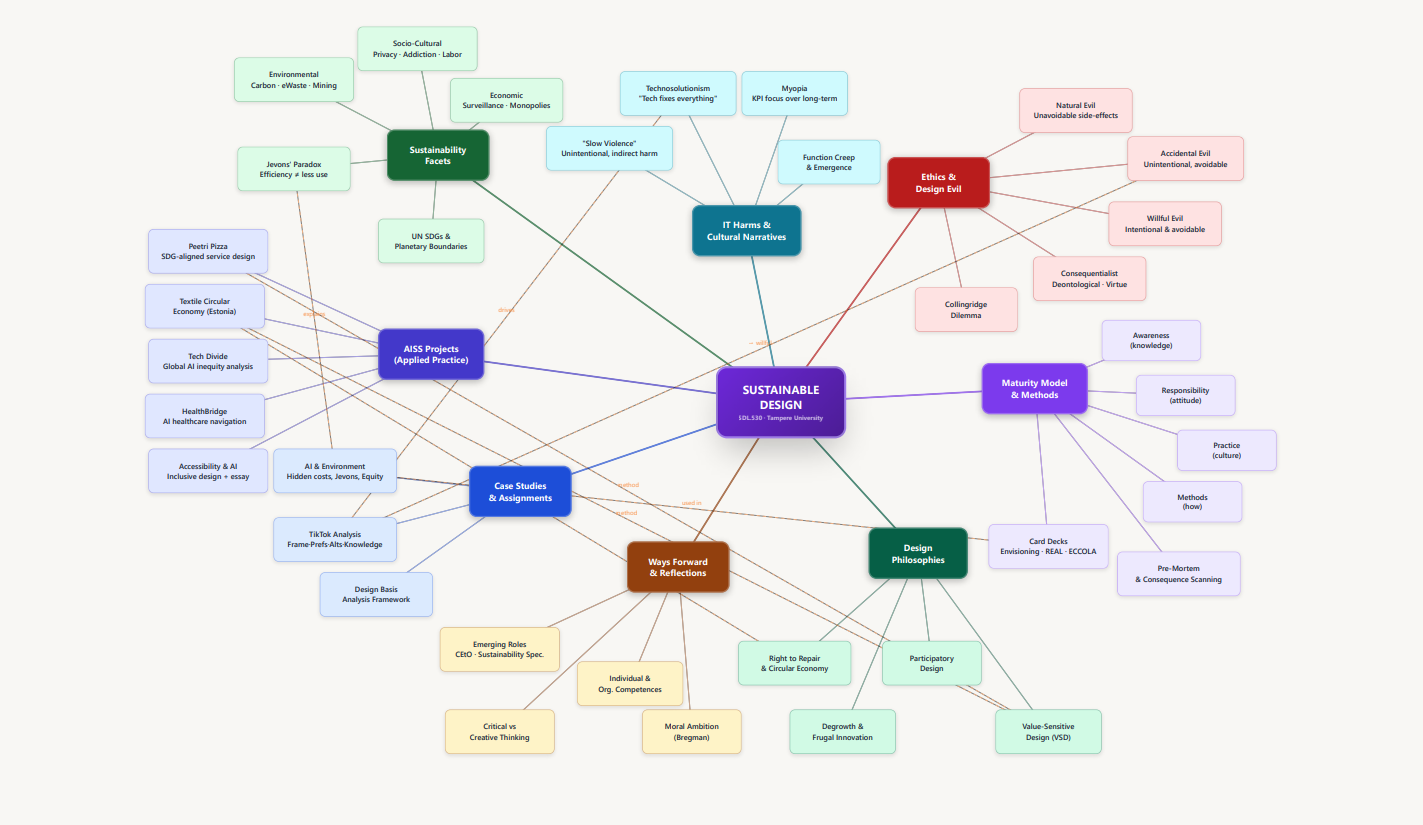
The supporting course mind map for SDL.530 ties this project back to the broader theoretical arc of the semester — situating infinite scroll design within concepts like the Collingridge dilemma (change is easy before harm is foreseen, but expensive once it's visible), the natural/accidental/willful evil spectrum for evaluating design harm, and Value-Sensitive Design as a philosophy for embedding user values into the design process from the outset.
Skills Demonstrated: Value-Sensitive Design, stakeholder analysis, root-cause analysis (5 Whys), ethical framework application (consequentialist, deontological, and virtue ethics lenses), sustainability-oriented UX design, policy analysis (EU Digital Services Act), workshop/curriculum design, and cross-functional collaboration.
Details of the entire project and final deliverables can be found here: Google Drive
Category: masters portfolio
153 
0

Comments